
Physical Symptoms of Travel Anxiety
Alongside these unpleasant psychological symptoms, there are, of course, multiple physical symptoms. Reassuringly, all of these are caused by the same threat response triggered by our anxious brain – and are simply the result of high levels of adrenaline and cortisol.
Although unpleasant, they are – we promise – harmless.
Having spoken with our own community, below are just a few of these symptoms:
- Heart palpitations
- Dizziness or light-headedness
- Rapid or shallow breathing
- Nausea
- Stomach cramps/diarrhoea (always fun on a flight)
- Panic attacks
- Feeling hot
- Generalised feeling of anxiousness
- Tight chest
- Jelly legs or trembling
- Tense muscles
- Dry mouth
- Needing to wee more
- Feelings of derealisation or depersonalisation
Distracting, frightening and enough to make us consider cancelling a trip, the symptoms of travel anxiety are both real and distressing.
‘Anxiety gives me heart palpitations – I’m terrified of having these on a plane or while being away. I’ve not been abroad for four years. Have had a fear of flying since I was around 8, but this has now got worse into a fear of being away from home’ – Community member
Behavioural Symptoms
‘Watch your thoughts. They become words. Watch your words. They become actions. Watch your actions. They become habits. Watch your habits. They become character’ – (Brewer, 2021)
Finally, all of the above – the dizzying thoughts and the physical symptoms – ultimately trigger us to act or behave in a certain way.
This is down to what psychologists call the cognitive-emotive loop and it works a little like this.
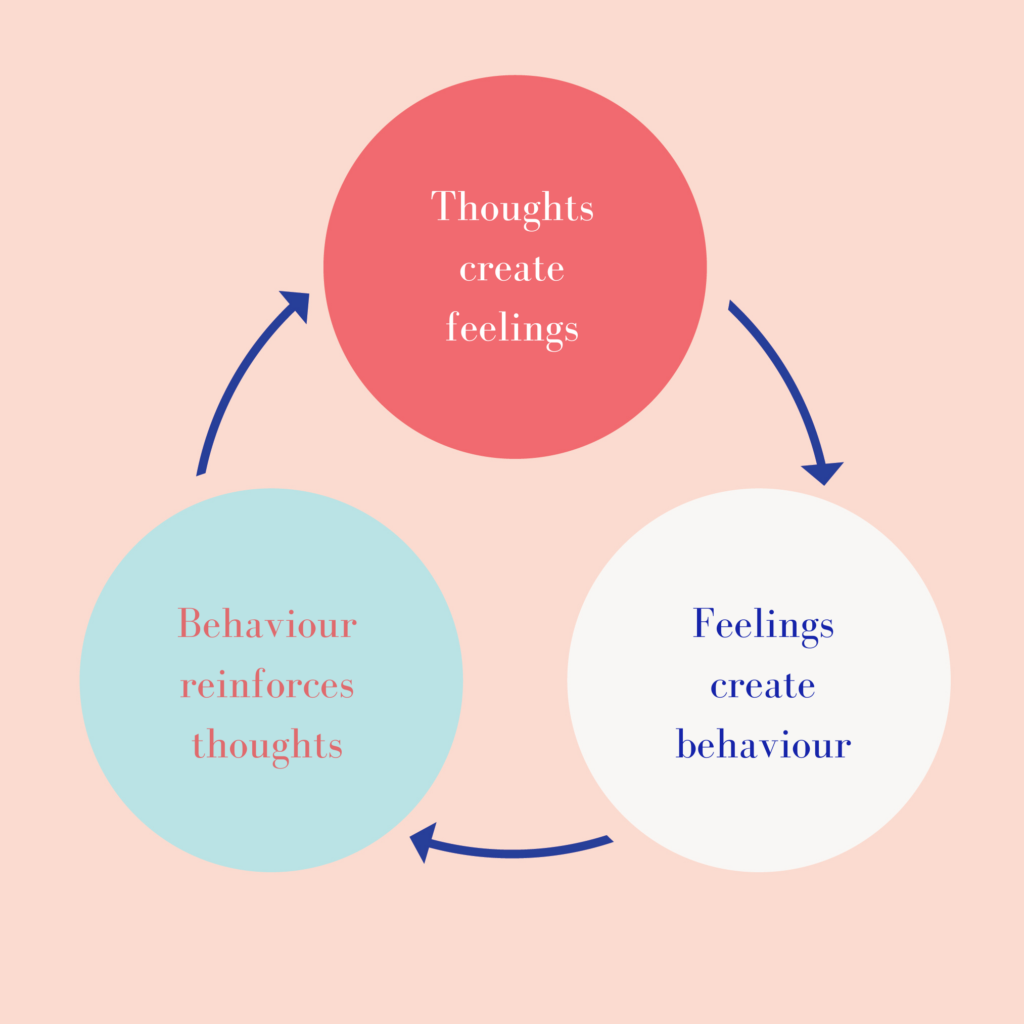
- A thought enters our mind – let’s say it’s: ‘I have to board a flight tomorrow. I don’t think I can do it’
- This thought then produces immediate feelings and emotions: in this case, fear, worry and anxiety
- Reacting to these unpleasant feelings, we then begin to adopt certain behaviours. For example, we might start to ruminate even more on these feelings or thoughts, or we might ‘flee’ the situation altogether and cancel the flight.
The result? This behaviour validates your initial thoughts and feelings; reinforcing the loop of unhelpful thinking (remember, our anxious brain learns through action and behaviour).
The most common types of behaviour triggered by anxious thoughts tend to include:
Avoidance
The most obvious consequence of travel anxiety is, of course, avoidance. Avoidance at all costs.
When our brain declares something is dangerous or frightening, we shift into a flight or fight mode (remember our brains can’t differentiate between thoughts and reality). In this case, the most obvious solution is to therefore flee – to avoid travelling altogether.
The result? You are ironically likely to be more anxious than if you actually went on the trip. Our anxious brain feels justified and it believes that the threat it warned you against was indeed real.
Safety-Seeking Behaviour
In short, safety seeking behaviour is the equivalent of scampering across the Serengeti whilst trying not to get eaten – hiding sporadically behind boulders and army crawling through grassy banks.
Yet, you’re not in the Serengeti – you’re in Heathrow Terminal 5.
Like any behaviours linked to anxiety, safety-seeking behaviour does have its uses – it can provide short-term reassurance and comfort, and helps to (momentarily) ease anxiety. Back in the day, safety seeking behaviour is what kept us alive.
However, in the long term, this behaviour becomes an unhelpful crutch that ultimately prevents us from facing our anxieties alone; independently and with confidence.
Safety seeking behaviours might include:
- Only wanting to travel with a certain person
- Avoiding certain modes of transport
- Only sitting in certain places (e.g. near an exit)
- Avoiding eating certain foods when away
- Regularly ‘checking in’ with yourself e.g. “Am I anxious?” “How am I feeling?”
- An over-reliance on distraction, e.g. your mobile phone
- Needing to be close to a wall (to lean against)
These behaviours might help you get on that plane, but they are ultimately retaining anxiety in the long term, causing you to constantly monitor the situation in case you need to ‘deploy’ your emergency practices once again.
As we want to learn to be comfortable with anxiety, to observe it, but not to react to it, these behaviours therefore become redundant.
It’s time to say goodbye to the aisle seat, or, our dearest of friends – the wall.
Worry Bingeing (Rumination)
‘If you realise, “I don’t want to be thinking about this, but I feel like I can’t stop,” that’s when you know your thinking is compulsive and is considered rumination’ – (Greenberg, 2021)
One final behavioural symptom of travel anxiety is rumination (or, as I like to call it, binge-worrying).
Closely aligned with intrusive thoughts and ‘what if’ thoughts, rumination is far more than just ‘thinking’ and far more destructive. Rumination is the near obsessive worrying and thinking about one particular thing – over and over, without end.
Most ruminators are convinced that by doing this, they’ll somehow glean insight into their lives or problems. However this is rarely the case. Instead, these thoughts tend to gather like a storm – leaving us feeling dark, sad and even more confused than when we started.
Indeed, trying to worry your way through rumination is a fool’s errand.
This is a common behaviour amongst those with travel anxiety, who may spend hours ruminating about a potential trip, before even booking it. However, and as we’ll touch upon as this course progresses, there are plenty of ways to break free of rumination: to dispel that intoxicating belief that by overthinking something, you’ll prevent disaster.
As champion ruminators (it really was one of our favourite pastimes), giving up this habit has been incredibly difficult. However, when we did divert ourselves from it, our travel anxiety significantly improved.